American Heart Association
BLS Initial and Renewal Classes
Central Florida
Hands-on AHA BLS classes built on the 2025 Guidelines — by appointment, or on-site at your facility. Walk out with your official American Heart Association certification the same day.
We Don't Just Hand You a Card.
We Build Confidence and Competence.
Anywhere can certify you. At Cardiac Edge, the card is the receipt — the product is what you walk out able to do. The American Heart Association's BLS Provider course trains you to recognize life-threatening emergencies, deliver high-quality chest compressions, give effective breaths and ventilations, and put an AED to work early. In every AHA BLS class we run across Central Florida — initial certification or renewal — those skills are taught hands-on by AHA-certified instructors, and we don't just teach the how. We teach the why behind everything. Because providers who understand why a skill works don't freeze when it counts. You'll leave with your official American Heart Association BLS certification in hand, and you'll walk out with more confidence and competence than ever before. That's the entire point.
Step Inside a Real Cardiac Edge BLS Class
Most training companies tell you their classes are different. We'd rather show you ours.
This Is What Separates Us From Every Other CPR Class
Press play and watch how we actually teach — real manikins, real repetition, real explanations of the why behind every rate, ratio, and pause. A few minutes in, you'll understand why our students leave different than they arrived.
- How we break down each skill until it's muscle memory — not memorization
- Why we explain the reasoning behind every guideline, not just the steps
- What a class feels like when the goal is competence, not attendance
 Press Play — Watch How We Teach
Everything You'll Master in Your AHA BLS Class
Your class covers the full American Heart Association BLS curriculum — every skill taught hands-on, skill by skill, until you can perform each one with confidence. Here's exactly what you'll learn, and why each piece matters.
High-Quality CPR — Adult, Child and Infant
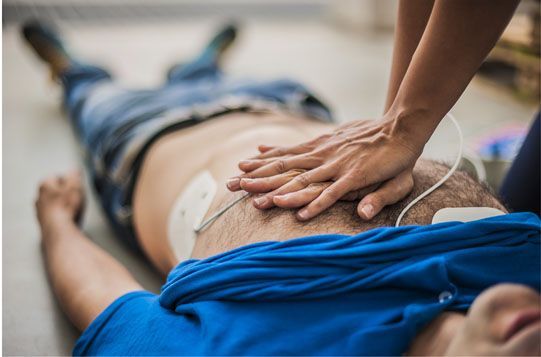
This is the heart of BLS, and "push hard, push fast" is only the slogan. You'll train to the AHA's measurable standards: a rate of 100 to 120 compressions per minute , full chest recoil, interruptions under ten seconds — and the right depth for every patient: an inch and a half for the infant, about two inches for the child, and at least two inches for the adult — because adults come in all sizes. 😉
Most importantly, you'll learn proper hand placement and body technique — so the mechanics do the work, your compressions don't fade, and what you deliver isn't just CPR. It's high-quality CPR, the kind that actually moves blood and saves brains.
Compression-to-Ventilation Ratios — and the Why Behind Them
One rescuer, every patient: 30 compressions to 2 breaths. Here's the why most classes never teach: it takes about 15 compressions just to build enough pressure to move blood — and the 8 to 10 seconds it takes to stop, give two breaths, and get back on the chest costs you about half of it. At 30:2, you build pressure and keep enough through the pause. At 15:2 alone, you'd build it, lose it all, and start from zero every single cycle.
Add a second rescuer and the pause nearly disappears. The adult stays at 30:2 — adult arrests are cardiac, so we're thinking heart, and we're happy with the air. But pediatric arrests are respiratory — we're thinking air. With two rescuers, half the compressions take half the time, you only lose half the pressure — so 15:2 keeps the blood moving and delivers twice the breaths a child actually needs. Hear it once explained this way, and you'll never have to memorize it again.
Bag-Valve-Mask Ventilation — the Skill That Separates Providers
Ask anyone who's worked a real resuscitation: the bag-valve-mask is one of the most difficult — and most important — skills in BLS. A poor mask seal moves air everywhere except into the lungs, and it's the skill most providers quietly hope nobody watches them perform.
Not in our class. You'll learn proper airway positioning, the E-C clamp technique, and how to squeeze just enough volume to make the chest rise — for adults, children, and infants. Before your class ends, you will get a perfect seal with visible chest rise. We make sure of it — so the next time you pick up a BVM, it's with the confidence and competence of someone who has truly done it.
Early AED Use, the Chain of Survival — and When the Pads Change
Early defibrillation is the single biggest survival multiplier in sudden cardiac arrest — and one of the links in the BLS Chain of Survival you'll own, along with early recognition and immediate high-quality CPR. You'll learn exactly when and how to deploy an AED, what the machine is analyzing while you work, and how to keep compressions running around analysis and shock so the device never slows your team down.
You'll also learn when pediatric pads become adult pads: age eight, or the first signs of puberty — and here's what most classes miss: puberty can show up at nine, ten, eleven. Expose the chest and see underarm hair or the first signs of breast development, and you're no longer treating a child — your entire algorithm changes. Two-rescuer 15:2 becomes 30:2, rescue breathing slows from once every three seconds to once every six, and the pediatric heart-rate-under-60 rule disappears — they simply need a pulse. One observation, three changes. That's why we teach the why.
Rescue Breathing — and the Pulse Check That Guides Everything
When a patient has a pulse but isn't breathing, rescue breathing keeps them alive — once every two seconds for the infant, once every three for the child, once every six for the adult. We make every rate stick with memory hooks you'll still have years from now.
And here's the key most providers miss: every two minutes, you stop and check the pulse — and you let it guide the way. No pulse, or an infant or child with a heart rate under 60? You move to CPR immediately. We call it buying your two minutes — in pediatrics especially, you'll learn to recognize when you must act for two minutes before anything else, and when you can step away to get help. It's the difference between following steps and understanding the patient in front of you.
Choking Relief — Adult, Child and Infant
Foreign-body airway obstruction is the emergency you're most likely to meet outside of work — at a restaurant, at a family dinner, in a waiting room. You'll master relief techniques for adults, children, and infants, both conscious and unconscious , including what changes the moment a choking patient goes down.
And yes — there's a why here too. The infant technique is completely different from the adult's, and once you understand the reason, you'll never confuse the two under pressure.
High-Performance Team Dynamics
Real resuscitations are team events, and a disorganized team loses minutes a patient doesn't have. You'll put every skill together as a team member and a team leader during multirescuer CPR: clear roles, closed-loop communication, and seamless compressor rotation so quality never drops.
This is where the class comes alive — full scenarios, every position, until the choreography of a working code feels natural. It's also the foundation you'll build on if ACLS is in your future.
Special Considerations You'll Train For
Real patients don't always look like the manikin. Your class covers the situations that change your approach — and exactly what to do differently in each one.
Opiate Overdose
Recognizing an opioid-associated emergency, why ventilation comes first, and where naloxone fits into your response.
Pregnancy
What changes when your patient is pregnant — and the adjustments that protect two lives at once.
The Obese Patient
Hand placement, depth, and airway adjustments that keep CPR and ventilation effective for every body type.
Advanced Airways
Once an advanced airway is in place, everything changes: one breath every six seconds while compressions never stop.
Initial vs Renewal — Which BLS Class Do You Need?
A renewal BLS class is for providers who hold an American Heart Association BLS certification that has not expired. An initial class is for first-time students — or anyone whose AHA certification has already expired. Online-only and non-AHA cards never qualify for a renewal; only a genuine, unexpired AHA BLS certification does.
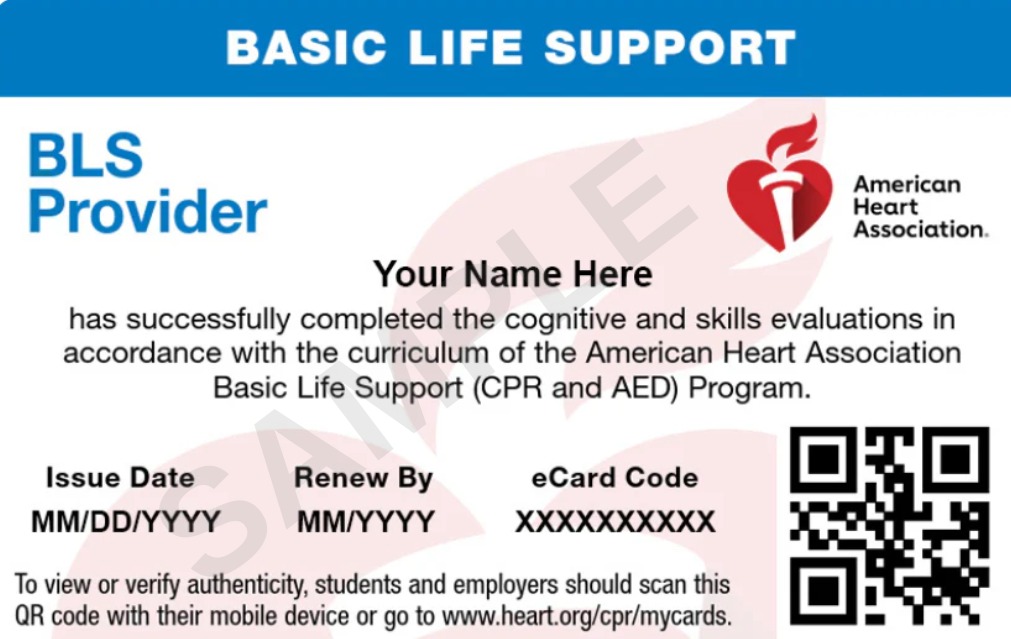
Either way, the result is the same: your official American Heart Association certification is issued the same day as your class , it's valid for two years, and anyone can verify it at the AHA's official portal, ecards.heart.org. Initial classes typically run three to four hours; renewals move faster for current providers — usually around two and a half.
Already finished the AHA HeartCode BLS online course? You only need the hands-on portion — book just the skills session.
- Initial BLS Class $75
- BLS Renewal Class $65
- HeartCode BLS Skills Session $75
AHA BLS Training for Central Florida's Providers, Students and Medical Practices
Central Florida, FL is really eight counties stitched together along the I-4 growth corridor, and the medical work spreads out just as wide: Orlando's Medical City research campus, the aerospace clinics of the Space Coast, the beach-town practices down the Daytona coast, and the dense web of senior care feeding the nation's largest retirement community to the west. The big hospital systems anchoring those hubs train their own staff in-house; the thousands of independent dental offices, physical-therapy clinics, urgent cares and small medical practices scattered between them do not, and their AHA cards still come due every two years. Cardiac Edge exists for that second group across the whole region, bringing AHA BLS and ACLS certification to the practice by appointment, at the office itself or at a Central Florida training space we arrange. There is no waiting on a hospital education department's calendar and no shutting the clinic to send people across the county to a fixed classroom. Whether it is one dentist in Volusia or a six-person PT team near Lake Nona, the training is real hands-on skills practice built around the schedule of a practice that has patients to see. Across a service area this large and this spread out, the offices that keep moving are the ones that bring the certification to their door instead of chasing it across the corridor.
American Heart Association BLS Classes — Frequently Asked Questions
Every question we hear about AHA BLS certification in Central Florida, answered clearly and completely. Select a category below to find what you need.
How much does a BLS class cost at Cardiac Edge? +
An initial AHA BLS Provider class at Cardiac Edge is $75. A BLS renewal is $65 for providers who hold a current, unexpired American Heart Association card. If you have already completed the AHA HeartCode BLS online portion, the hands-on skills session is also $75. Active military and returning students receive 15% off at the time of registration. Group and BLS training at your location for facilities, practices, or schools is quoted by team size. Contact us for available dates. Valid ID or prior enrollment verification required at registration.
When will I receive my AHA BLS certification card? +
Your official American Heart Association BLS Provider certification is issued the same day you complete your class and pass your skills evaluation. There is no waiting period. Your employer or program can verify it immediately at the AHA's official verification portal, ecards.heart.org. The certification arrives by email and can be downloaded, printed, or shared digitally.
How long is a BLS certification class? +
Initial BLS classes typically run three to four hours, with an average of around three and a half hours depending on class size. Renewal classes move faster for current providers and typically run about two and a half hours. Every class includes the full hands-on skills evaluation required for AHA certification — not just a written component.
What is the difference between an initial and a renewal BLS class? +
A BLS renewal is for providers who hold a current, unexpired American Heart Association BLS certification. A renewal covers the same core skills in a condensed format and is priced at $65. An initial class is for first-time students and for anyone whose AHA certification has already expired — it runs longer and is $75. Online-only cards or non-AHA certifications do not qualify for renewal; those students take the initial course.
Is BLS the same as CPR? +
BLS includes CPR, but it is a provider-level certification designed for healthcare professionals, clinical students, and first responders — not a general public CPR class. BLS adds bag-valve-mask ventilation, multirescuer team dynamics, and provider-grade skills to the CPR foundation. General CPR courses are designed for workplaces and the general public. If you are working in or studying healthcare, BLS is the standard your employer or program requires.
How much does BLS certification cost? +
At Cardiac Edge, initial AHA BLS certification is $75 and renewal is $65. The HeartCode BLS hands-on skills session for students who have completed the online portion is also $75. These prices include the AHA certification fee — there are no hidden add-ons. Contact us for available dates.
How much is a BLS class near me in Central Florida? +
A BLS class near you in Central Florida is $75 for the initial course and $65 for a renewal at Cardiac Edge. Classes run by appointment — request a date that works for you. We also bring BLS training at your location to facilities across eight Central Florida counties — contact us for a group quote.
How much does group BLS training cost? +
Group and BLS training at your location rates are quoted by team size. Whether you have a small dental practice, a large nursing unit, or an entire department to certify, we build the quote around your headcount and location. Call us at (407) 809-7870 or submit an training at your location request online and we will put a quote together for your team. Request group training at your location.
Is BLS cheaper for groups? +
Yes. Group rates apply when we come to your facility or when you bring a team to a session we arrange. Rates are quoted by team size — the more providers you certify at once, the better the per-person cost. Contact us with your headcount and we'll put together a quote.
Do you offer a discount for students or military? +
Yes. Active military and returning students receive 15% off at the time of registration. The discount is applied when you register — valid ID or prior enrollment verification is required. New students who have not previously certified with us are not eligible for the returning-student rate, but the standard pricing is already straightforward: $75 initial, $65 renewal. Discount applied at time of registration; valid ID or prior enrollment verification required.
What payment methods do you accept for a BLS class? +
We accept all major credit and debit cards. For group or training at your location invoiced to an employer or institution, contact us to arrange payment terms. Book your session by appointment.
Can my employer pay for my BLS class? +
Many employers, hospitals, and clinical programs reimburse BLS certification fees or pay directly for group training at your location. If your employer is paying, contact us so we can arrange invoicing or a group booking. If you are paying out of pocket for reimbursement, you will receive a receipt at the time of registration.
Does insurance cover BLS certification? +
Health insurance does not typically cover BLS certification, as it is a professional credentialing course rather than a medical service. Some employers include BLS reimbursement in their education benefits or professional development budgets. Check with your HR department or clinical coordinator if you believe your institution covers the cost.
Do I get my BLS card the same day as class? +
Yes. Your official American Heart Association BLS Provider certification is issued the same day you complete your skills evaluation. It arrives by email and is available to download, print, or share digitally. Your employer or program can verify it immediately at ecards.heart.org.
Is the BLS card digital or paper? +
The American Heart Association issues digital certifications for all BLS Provider completions. Your certification is emailed to the address you register with and is stored in your AHA account at the official AHA portal. You can print it as a physical copy if your employer requires a printed card, but the certification itself is the official certification — not a printout from a third-party training company.
How do I access my digital BLS certification? +
After your class, the American Heart Association sends your certification link to the email address you registered with. You can also log into or create a free account at ecards.heart.org to view, download, or share your card at any time. If you do not see the email within 24 hours of class, check your spam folder first, then contact us and we'll help you track it down.
Can I print my AHA BLS certification? +
Yes. You can print your certification directly from ecards.heart.org or from the email the AHA sends after your class. Most employers and nursing programs accept either the digital version or a printed copy. If your specific employer requires a plastic wallet card format, contact us — we can discuss options for your situation.
How long does it take to get my BLS card after class? +
Your AHA certification is typically issued the same day as your class, often within a few hours of completion. In some cases it may arrive the following business day depending on AHA system processing. If 48 hours have passed and you have not received your card, contact us and we will follow up with the AHA on your behalf.
Does my AHA BLS card show my renewal date? +
Yes. Your AHA BLS Provider certification shows both your completion date and your expiration date — two years from the date of issue. This makes it straightforward for HR departments and clinical coordinators to confirm your card is current without additional verification steps.
Does HR accept AHA certifications? +
AHA BLS Provider certifications are widely accepted by healthcare employers and accredited clinical programs. Every genuine AHA certification can be independently verified at ecards.heart.org, which is the standard employers use to confirm authenticity. Confirm your employer's specific acceptance requirements before enrolling, as individual credentialing policies can vary. AHA BLS Provider certifications are accepted by most healthcare employers and accredited programs. Confirm acceptance requirements with your employer or program before enrolling.
How do I verify my BLS certification online? +
Every genuine American Heart Association BLS certification can be verified at ecards.heart.org using the card number on your certification. Your employer, school, or program can verify your card independently through the same portal — they do not need your password or account login, only the card number. This is the standard verification method used by healthcare employers across Central Florida.
Can my employer verify my AHA card number? +
Yes. Any genuine AHA certification can be verified at ecards.heart.org. Employers enter the card number and can confirm the name, course, issue date, and expiration date without needing your login credentials. This public verification is one of the key reasons healthcare employers and nursing programs require AHA specifically — the card is independently auditable.
What if I lost my BLS card? +
Because AHA issues digital certifications, a lost card is straightforward to recover. Log in to your account at ecards.heart.org to reprint or re-download your card. If you need help finding your card or accessing your AHA account, contact us and we will assist you through the AHA certification reprint process.
How do I get a replacement BLS card? +
AHA certification reprints are available through ecards.heart.org using the email address you registered with. If you no longer have access to that email or are having trouble accessing your AHA account, contact us — we can help you initiate the reprint process through the AHA's official channels.
How can I tell if a BLS certification is a real AHA card? +
Two checks confirm a genuine AHA certification. First, the card face: real AHA certifications display the American Heart Association name, not the name of a training company or website. Second, verify the card number at ecards.heart.org — every legitimate AHA card will return a valid result. If a card cannot be verified at that portal, it is not an AHA credential.
What is the AHA course code for BLS Provider? +
The course is officially named the AHA BLS Provider Course, and that is exactly how it appears on your certification — there is no separate course name for initial versus renewal; both result in the same BLS Provider certification. Your certification will display the course name — BLS Provider — along with your completion date and expiration date.
Will my new job accept my old BLS card? +
As long as your current AHA BLS Provider certification is not expired, most healthcare employers will accept it regardless of which AHA Authorized Training Site issued it. The certification is issued by the American Heart Association directly — not by the training site — and is verifiable at ecards.heart.org. If your card is expired, you will need a new initial course before starting your new role. Check the class schedule and book a class. Confirm acceptance requirements with your specific employer before enrolling.
What is BLS renewal vs initial certification? +
An initial BLS class is for first-time students and for anyone whose AHA certification has already expired — it runs three to four hours and is $75. A BLS renewal is for providers whose AHA card is still current and unexpired — it typically runs about two and a half hours and is $65. The renewal covers the same core AHA BLS curriculum in a condensed provider-focused format.
Is BLS renewal shorter than the initial class? +
Yes. Renewal classes are shorter than initial classes because they are designed for providers who already hold a current AHA BLS card and have baseline familiarity with the skills. Renewal classes typically run about two and a half hours versus three to four hours for an initial class. Both classes include the full hands-on skills evaluation.
Do I need to take the full BLS class again for renewal? +
No. If your AHA BLS card is still current, you take the renewal class — a condensed format designed for working providers that covers the same AHA curriculum without repeating the full beginner curriculum. If your card has already expired, AHA rules require the full initial course regardless of your experience level.
How early can I renew my BLS? +
You can take a renewal class any time before your card expires. Your new AHA certification runs two years from the date of your class, which is why most providers schedule their renewal in the final 60 to 90 days before expiration to stay ahead of employment credentialing deadlines. Renewing too early — more than about three months out — means your new two-year cycle begins from the class date, which effectively shortens the term of your prior card.
Can I renew BLS if it's already expired? +
No. Once an AHA BLS certification has passed its expiration date, you must take the full initial course — not the renewal. This is an AHA policy, not a Cardiac Edge policy. Initial BLS classes are scheduled by appointment. Contact us for the next available date.
Can I renew BLS online? +
There is no fully online BLS renewal recognized by the American Heart Association. Every AHA BLS certification — initial or renewal — requires an in-person, hands-on skills evaluation conducted by an AHA-certified instructor. The AHA HeartCode BLS blended pathway includes an online Part 1, but the hands-on skills session is mandatory and must be completed in person. Online-only cards are not valid AHA credentials.
How do I renew my BLS certification? +
To renew your AHA BLS certification, you need a current, unexpired AHA BLS Provider card and a seat in a renewal class. At Cardiac Edge, you can reserve a renewal session by appointment, or we can bring group renewal to your facility. Request a date and register online. Your new certification is issued the same day.
Can I renew BLS 6 months early? +
Technically yes — your card is still current, so you qualify for renewal rather than the initial course. However, renewing six months early means your new two-year cycle starts from your class date, not from your old expiration date. You would lose roughly six months of coverage from your prior card. Most providers renew in the 60-to-90-day window before expiration to minimize that gap while still meeting employer deadlines.
What is the 2-year BLS renewal cycle? +
AHA BLS Provider certifications are valid for two years from the date of issue. Your certification shows both the issue date and the expiration date. Healthcare employers and nursing programs in Central Florida typically verify that your card will remain valid through your employment or clinical rotation period, so renewing before the card expires — rather than after — is important for continuous compliance.
How often do healthcare workers need to recertify BLS? +
The AHA BLS Provider certification is valid for two years, and most healthcare employers require renewal before the card expires to maintain continuous compliance. Many clinical settings require that your card remain active throughout your employment or rotation, meaning you may need to renew before your card technically expires to avoid a lapse in credential coverage.
What is HeartCode BLS? +
HeartCode BLS is the American Heart Association's official blended-learning pathway for BLS certification. It consists of two parts: an online self-directed learning module (Part 1) that you complete at your own pace, followed by a mandatory in-person hands-on skills session (Part 2) with an AHA-certified instructor. Completing both parts earns you the same official AHA BLS Provider certification as a traditional classroom course.
How does HeartCode BLS work? +
HeartCode BLS works in two steps. First, you complete the AHA's online HeartCode BLS module — an adaptive digital course that covers the BLS curriculum through simulations and knowledge checks, typically taking one to two hours as stated by the AHA. Second, you schedule and complete a hands-on skills session with an AHA-certified instructor who evaluates your CPR technique, AED use, and ventilation skills in person. Upon successful completion, your AHA certification is issued the same day as your skills session.
Can I do BLS certification fully online? +
No. The American Heart Association requires every BLS certification to include an in-person hands-on skills evaluation — there is no fully online pathway that results in a legitimate AHA credential. The HeartCode BLS blended pathway includes an online learning component, but the skills session with an AHA instructor is mandatory. Any website offering fully online BLS certification without an in-person component is not issuing a genuine AHA card.
How long is the HeartCode BLS online portion? +
The AHA states that the HeartCode BLS online module typically takes one to two hours to complete, but individual completion time varies because the course uses an adaptive algorithm that responds to your performance. Some providers move through it quickly; others spend closer to two hours. You complete it at your own pace before scheduling your skills session.
Where can I complete my HeartCode BLS skills check in Central Florida? +
Cardiac Edge hosts HeartCode BLS skills sessions by appointment. We also offer skills sessions at facilities across Orange, Seminole, Osceola, Lake, Volusia, Brevard, Polk, and Sumter counties. The skills session fee is $75. View HeartCode skills session availability.
Is HeartCode BLS accepted by hospitals and nursing programs? +
Yes. HeartCode BLS is an official AHA course and the resulting certification is identical to the card issued from a traditional classroom BLS class — the same AHA BLS Provider credential, the same two-year validity, verifiable at ecards.heart.org. Central Florida hospital systems and nursing programs that require AHA BLS accept HeartCode-issued cards. Confirm your employer's or program's specific acceptance requirements before enrolling. AHA BLS Provider certifications are accepted by most healthcare employers and accredited programs. Confirm acceptance requirements with your employer or program before enrolling.
Can nurses take HeartCode BLS? +
Yes. HeartCode BLS is appropriate for nurses, nursing students, and all healthcare providers who need AHA BLS certification. The blended format is particularly convenient for working nurses who want to complete the knowledge portion on their own schedule before attending an in-person skills session. The resulting certification is the same AHA BLS Provider credential.
What is the difference between HeartCode BLS and a regular BLS class? +
Both pathways result in the same AHA BLS Provider certification. A traditional BLS class combines online knowledge content and hands-on practice in one session lasting three to four hours. HeartCode BLS splits the learning into an online module you complete on your own time (one to two hours) and a separate in-person skills session (approximately 60 to 90 minutes). The HeartCode path is convenient for providers who want flexibility in when and where they complete the knowledge portion.
Do I need to bring anything to a HeartCode BLS skills session? +
Yes. You must bring your valid HeartCode BLS Part 1 completion certificate — a printout or digital copy of the completion record from the AHA's HeartCode system. Without a valid completion record, the skills session cannot result in AHA certification. Wear comfortable clothing you can move in, and arrive a few minutes early to complete any required paperwork.
I completed HeartCode BLS online — can I do just the skills session at Cardiac Edge? +
Yes. Bring your valid HeartCode BLS Part 1 completion certificate — from our site or any other AHA-authorized source — and we'll conduct your hands-on skills evaluation by appointment, or at your facility. The skills session is $65, and your AHA certification is issued the same day upon successful completion. Schedule a skills session.
What is BLS certification? +
AHA BLS (Basic Life Support) is the American Heart Association's certification for healthcare providers — nurses, physicians, dental professionals, paramedics, medical assistants, allied health students, and others who may need to respond to a cardiac or respiratory emergency in a clinical setting. The BLS Provider course covers adult, child, and infant CPR, AED use, bag-valve-mask ventilation, choking relief, team resuscitation dynamics, and the AHA Chain of Survival. It is valid for two years and is the standard credential recognized by healthcare employers and nursing programs throughout Central Florida.
What is BLS for healthcare providers? +
BLS for Healthcare Providers is the AHA's foundational life support certification designed for clinical professionals and students. It distinguishes itself from consumer CPR courses by including bag-valve-mask ventilation, provider-level rescue breathing rates, multirescuer team dynamics, and skills scenarios relevant to clinical settings. It is the certification required by hospitals, nursing schools, and most allied-health programs — not a basic workplace CPR card.
What does BLS certification cover? +
The AHA BLS Provider course covers the complete 2025 AHA Guidelines curriculum: high-quality CPR for adults, children, and infants; AED operation including pediatric pad rules; bag-valve-mask ventilation; rescue breathing rates for every age group; early recognition of cardiac and respiratory arrest; relief of foreign-body airway obstruction (choking) in all ages; high-performance team resuscitation dynamics; and special resuscitation scenarios including opioid overdose, pregnancy, and the patient with an advanced airway.
What skills are taught in a BLS class? +
BLS skills training covers hands-on evaluation in all of the following areas: adult, child, and infant one-rescuer and two-rescuer CPR; correct compression depth, rate, and recoil; effective breaths using a pocket mask and bag-valve-mask; AED use from device activation through shock delivery; rescue breathing for cardiac arrest and respiratory arrest; choking relief for conscious and unconscious patients of all ages; and team resuscitation communication in a clinical role.
Is BLS certification required for nursing school? +
Many nursing and allied-health programs in Central Florida require current AHA BLS certification before clinical rotations begin. The specific requirement varies by program. If you are unsure what your program requires, contact your clinical coordinator or program director — but in nearly every case, when a healthcare program requires CPR or life support certification, they mean AHA BLS Provider, not a general CPR card.
Is BLS worth it? +
For anyone working in or studying healthcare, BLS certification is not optional — it is a standard requirement for employment and clinical placement. Beyond compliance, the skills taught in AHA BLS are the foundation of effective emergency response: knowing how to perform high-quality CPR, operate an AED, and manage an airway correctly matters in real emergencies. The certification is two years and costs $75 for initial certification at Cardiac Edge.
Do I need any prior experience to take a BLS class? +
No. The AHA BLS Provider course is designed to train both first-time students and experienced providers. Prior CPR experience is helpful but not required. The course starts with the fundamentals and builds to more advanced team resuscitation scenarios. Most students complete the hands-on skills evaluation on the first attempt.
What age can you take BLS? +
The AHA BLS Provider course is designed for healthcare providers and clinical students — there is no strict minimum age, but the course assumes a healthcare provider context. Most students are 16 and older. If you are a younger student in a healthcare program, contact us to confirm enrollment eligibility for your specific situation.
Can a non-healthcare worker take BLS? +
Yes. Anyone can enroll in an AHA BLS Provider class. While the course is designed for healthcare professionals, lay responders, fitness trainers, school staff, and others who want provider-level life support skills are welcome. If you are a member of the general public and do not need BLS specifically.
Can a medical assistant take AHA BLS? +
Yes. Medical assistants frequently take AHA BLS certification and many clinical employers require it. The BLS Provider course is appropriate for medical assistants, dental assistants, phlebotomists, pharmacy technicians, and other allied-health professionals whose role may involve responding to an emergency in a clinical setting.
What other AHA courses does Cardiac Edge offer? +
In addition to AHA BLS, Cardiac Edge offers the AHA BLS and ACLS certification courses in Central Florida. Advanced Cardiovascular Life Support (ACLS) for emergency medicine and critical care providers is available at this link. HeartCode skills sessions for all blended-learning completions are at this link.
What is the fastest way to get BLS certified in Central Florida? +
The fastest path is to request the next available BLS session by appointment — your AHA certification is issued the same day you complete your skills evaluation. Contact us to confirm the next open date, or request training at your location for groups.
Can I get BLS certified in one day? +
Yes. Initial BLS classes at Cardiac Edge are completed in a single session — typically three to four hours — and your AHA certification is issued the same day. Register for a class, attend, pass your skills evaluation, and leave certified. Check the calendar for available dates. See available dates.
Are there BLS classes on weekends in Central Florida? +
We schedule by appointment, so we can often arrange a weekend date for your group. Reach out through our at-your-location request form, or contact us to confirm available dates for your team or facility.
Can I take BLS and ACLS the same day? +
Completing both BLS and ACLS in a single day is a very long session and depends entirely on class availability. BLS typically takes three to four hours and ACLS is a full-day course on its own. Some providers complete BLS one day and ACLS the following day. Contact us to discuss scheduling options if you are working against a deadline. Learn about ACLS classes.
How many people are in a BLS class? +
Class sizes at Cardiac Edge are kept small to allow for quality hands-on practice with each student. The AHA sets instructor-to-student ratios for BLS to ensure every participant gets adequate manikin time and personalized skills feedback. For group training at your location, we scale the instructor and equipment count to match your team size.
What if I fail the BLS skills test? +
If you do not pass a skills station on your first attempt, your instructor will provide remediation and coach you through the technique before a recheck. Most students who need remediation pass on the recheck during the same class session. Individual results may vary, and in rare cases a second class session may be recommended. Individual results may vary.
Do I have to pass a written test for BLS? +
Yes. The AHA BLS Provider course includes a written knowledge assessment in addition to the hands-on skills evaluation. Both components must be completed satisfactorily to receive your certification. The knowledge test covers the cognitive content from the course and is not timed under pressure — most students who pay attention during the session pass straightforwardly.
Can I retake the BLS skills test the same day? +
In most cases, yes. If you need to retry a skills station, your instructor will provide remediation and allow a recheck during the same session. Whether a full retest can occur the same day depends on the nature of the issue and the instructor's judgment. Your instructor will guide you through the next step if remediation is needed.
What is the BLS pass rate? +
We do not publish pass-rate statistics. The AHA BLS course is designed so that providers who attend, engage with the material, and follow instructor coaching are able to complete the skills evaluation. Students who come prepared and focused on learning the skills — not just checking a box — consistently do well. Individual results may vary. Individual results may vary.
What if I need to cancel my BLS class? +
If you need to reschedule or cancel your registration, contact us as early as possible. Cancellation and reschedule policies are outlined at the time of booking. We add new dates regularly, so rescheduling to a different date is typically straightforward. Contact us for alternatives.
Do I need to buy anything before my BLS class? +
No. All required materials — manikins, AED trainers, bag-valve-mask devices, and course materials — are provided at every Cardiac Edge BLS class. You do not need to purchase a provider manual in advance, though you are welcome to review the AHA BLS Provider manual if you want to prepare. Just bring yourself, comfortable clothing, and your registration confirmation.
What should I wear to a BLS class? +
Wear comfortable clothing you can move in. BLS classes involve kneeling on a mat and performing chest compressions on a manikin — tight or restrictive clothing can make the hands-on portions uncomfortable. Scrubs or athletic wear work well. Arrive about 10 minutes early to check in and get settled before class starts.
Do I need a provider manual for BLS? +
The AHA BLS Provider manual is a helpful reference but is not required to bring to class. All course materials needed for the session are provided. If you want to study in advance, the AHA BLS Provider manual is available for purchase through the AHA's official store. Your instructor will cover all required content during the class.
Do you offer group BLS training for hospitals or practices? +
Yes. Group BLS training at your location is a core part of what we do. We bring the complete AHA BLS course — instructor, manikins, AEDs, and same-day certification issuance — to hospitals, dental practices, nursing schools, urgent care centers, and other facilities throughout the eight-county Central Florida region. Rates are quoted by team size. Request training at your location.
Can my whole nursing unit get certified at once? +
Yes. We routinely certify entire departments, units, and clinical teams in a single session by bringing the entire course to your location. We scale the instructor-to-student ratio to meet AHA guidelines regardless of team size, and every participant receives their AHA certification the same day. Contact us with your headcount and preferred dates for a quote. Request group training at your location.
Do you come to our facility for BLS training? +
Yes. Cardiac Edge provides BLS training at your location at your practice, hospital, school, clinic, or any facility across Orange, Seminole, Osceola, Lake, Volusia, Brevard, Polk, and Sumter counties. We bring everything — the instructor, manikins, AED trainers, and full course materials — and issue AHA certifications on the same day. Schedule training at your location.
Why does my employer require AHA BLS specifically? +
Healthcare employers and clinical programs require AHA BLS specifically because the American Heart Association's certification is built on peer-reviewed resuscitation science guidelines, requires in-person skills validation by a certified instructor, and produces a verifiable digital credential at ecards.heart.org. Non-AHA cards — including online-only certifications — cannot be independently verified and do not guarantee the same skills standard. AHA BLS is the recognized benchmark for healthcare provider life support competency.
Do hospitals accept online BLS certification? +
No. There is no legitimate fully online BLS certification — every valid AHA BLS card requires an in-person hands-on skills evaluation. Central Florida hospital systems and healthcare employers routinely reject online-only cards, even when those cards claim to follow AHA guidelines. Verify any certification at ecards.heart.org: if it does not appear there, it is not an AHA credential.
Is online-only BLS accepted by hospitals? +
No. Online-only BLS cards are not valid AHA credentials and are not accepted by healthcare employers and clinical programs in Central Florida. The American Heart Association requires every BLS certification to include a hands-on skills evaluation with an AHA-certified instructor. Online-only providers issue cards that look similar to genuine AHA credentials but cannot be verified at ecards.heart.org.
What CPR certification do hospitals accept in Florida? +
The credential accepted by virtually all Florida healthcare employers and nursing programs is the American Heart Association BLS Provider certification. Employers verify authenticity at ecards.heart.org. Some employers also accept AHA ACLS certification in addition to BLS, depending on the role. Confirm your employer's specific requirements, but if they require "CPR certification" for a clinical role, they almost always mean AHA BLS. Confirm acceptance requirements with your employer or program before enrolling.
Does my employer accept Red Cross instead of AHA? +
Employer acceptance policies vary. Many healthcare employers and nursing programs in Central Florida specify American Heart Association BLS because it is the recognized clinical standard, and their credentialing systems are built around AHA certification verification. Before assuming a Red Cross card will be accepted in a clinical setting, confirm with your HR department or clinical coordinator. If your employer requires AHA, the Cardiac Edge BLS class is the straightforward solution. Confirm acceptance requirements with your employer or program before enrolling.
Does AHA BLS count for nursing school? +
Yes. AHA BLS Provider certification is the standard required by nursing and allied-health programs across Central Florida for clinical rotations. Confirm the specific card requirement with your program director, but in nearly every case when a nursing program requires CPR or life support certification before clinicals, it means AHA BLS Provider — not a general CPR card.
When should I get BLS before starting nursing school? +
Most nursing programs require your AHA BLS card to be in hand before your first clinical rotation — not at orientation, but typically before any patient contact. Getting certified two to four weeks before your program start date gives you a comfortable buffer and ensures your card is active in the AHA system. Check available dates and register for the earliest date that works with your schedule. Contact us to confirm open seats.
What BLS card do Central Florida nursing programs require? +
Nursing and health sciences programs across Central Florida require a current American Heart Association BLS Provider certification before clinical rotations. Programs verify through the AHA certification portal and require the card to remain active throughout your clinical placement period. Contact your specific program for the exact timing and format requirements. Confirm requirements with your specific program before enrolling.
Does my employer accept HeartCode BLS? +
Employers verify any genuine AHA certification at ecards.heart.org — the source of the card (classroom or HeartCode) does not appear on the credential, only the certification itself. Check your specific employer's credentialing requirements to confirm their current policy on AHA certifications. Confirm acceptance requirements with your employer before enrolling.
Do Central Florida hospital systems require AHA BLS? +
Employers verify any genuine AHA certification at ecards.heart.org. Check your specific employer's current credentialing requirements directly with their HR or clinical education department to confirm what they require for your role. Confirm acceptance requirements with your employer before enrolling.
What happens if I use a non-AHA BLS card at my hospital job? +
Non-AHA cards that cannot be verified at ecards.heart.org are typically rejected during credentialing. In most cases this means you are required to obtain a valid AHA BLS credential before you can work in a patient care role — which means paying twice. The safest course is to get certified through an AHA Authorized Training Site before your start date.
Is BLS required for dental assistants in Florida? +
Many Florida dental practices require dental assistants to hold current CPR or BLS certification, and some practices specify AHA BLS specifically. Florida Board of Dentistry regulations may also factor in depending on the scope of services. Confirm your specific employer's requirements, but AHA BLS is the standard that satisfies the broadest range of dental employer and regulatory requirements in Florida. Confirm requirements with your employer or licensing board.
What CPR do dental offices need in Florida? +
Florida dental practices generally require staff CPR certification, and many specify American Heart Association BLS Provider because it is the most widely recognized healthcare-grade credential. Confirm with your specific employer or check your dental board requirements for your role.
What is the difference between BLS and CPR? +
BLS is the provider-level certification that includes CPR as its foundation but adds bag-valve-mask ventilation, multirescuer team dynamics, AED use, and clinical-setting resuscitation scenarios. CPR, in its basic consumer form, is designed for the general public and workplace responders — it does not include bag-valve-mask skills or the team dynamics component. If you work in healthcare or are entering a healthcare program, BLS is the standard your employer requires, not a basic CPR card.
Is AHA BLS the same as Red Cross CPR? +
They are different certifications. AHA BLS Provider is a provider-level course recognized by healthcare employers, nursing programs, and hospitals for clinical credentialing purposes. American Red Cross CPR courses are separate certifications with their own acceptance standards. Many healthcare employers in Central Florida specify AHA BLS by name in their credentialing requirements. Confirm with your employer or program which credential is required for your role before enrolling. Confirm acceptance requirements with your employer or program before enrolling.
BLS or ACLS — what do I need first? +
BLS first, always. AHA BLS is the prerequisite for ACLS. You must hold a current AHA BLS Provider certification before enrolling in an ACLS course — ACLS builds on BLS skills with advanced airway management, pharmacology, ECG rhythm interpretation, and team resuscitation for adult emergencies. If you need both, certify in BLS first, then enroll in ACLS. View ACLS class options.
What is ACLS and how is it different from BLS? +
ACLS (Advanced Cardiovascular Life Support) is the AHA's advanced provider course for emergency medicine and critical care professionals. While BLS covers the foundational life support skills all healthcare providers need, ACLS adds 12-lead ECG interpretation, advanced airway management, resuscitation pharmacology, team leadership, and megacode scenarios for adult cardiac emergencies. ACLS requires current AHA BLS as a prerequisite. View ACLS certification details.
Do I need BLS before taking ACLS? +
Yes. Current AHA BLS Provider certification is a prerequisite for every AHA ACLS course. You must hold a valid, unexpired AHA BLS card before enrolling in ACLS — this is an AHA requirement, not a training site policy. If your BLS has expired, you need an initial BLS class first, then ACLS. ACLS class information.
What is an AHA Authorized Training Center? +
An AHA Authorized Training Center (now called an AHA Authorized Training Site) is a training organization that has met the American Heart Association's standards for instructor certification, curriculum delivery, and course administration. Only Authorized Training Sites can issue genuine AHA certifications. Cardiac Edge is an AHA Authorized Training Site, which means every certification we issue is a real AHA credential verifiable at ecards.heart.org.
Does my BLS certificate need to be from an AHA Training Center? +
Yes. To be a genuine AHA certification, your BLS card must be issued by an AHA Authorized Training Site using official AHA curriculum and instructor certification. Certifications issued by sites that are not AHA-authorized — regardless of how the card looks or what "guidelines" it claims to follow — are not genuine AHA credentials and may be rejected by healthcare employers and programs.
Is CPR Certification in Central Florida AHA authorized at Cardiac Edge? +
Yes. Cardiac Edge is an AHA Authorized Training Site offering the AHA BLS and ACLS certification courses across Central Florida, including BLS and ACLS courses. Every certification issued through Cardiac Edge is a genuine American Heart Association credential, verifiable at ecards.heart.org, and accepted by healthcare employers and clinical programs that require AHA certification.
Where can I get AHA BLS certified in Central Florida? +
Cardiac Edge runs American Heart Association BLS classes by appointment and brings the complete course to your facility. Request a date, or request training at your location — we serve Orange, Seminole, Osceola, Lake, Volusia, Brevard, Polk, and Sumter counties, with same-day certification either way.
Which Central Florida counties does Cardiac Edge serve? +
Cardiac Edge serves all eight Central Florida counties: Orange, Seminole, Osceola, Lake, Volusia, Brevard, Polk, and Sumter. Reserve a session by appointment, and at-your-location team training is available across every county we serve.
Do you offer AHA BLS classes in Orange County, FL? +
Yes — both ways. Reserve a BLS session by appointment, or have us bring the complete course — instructor, manikins, and AEDs — to your practice, facility, school, or group anywhere in Orange County. Everything we offer there is on our Orange County AHA classes page.
Do you offer AHA BLS classes in Seminole County, FL? +
Yes. AHA BLS training at your location is available throughout Seminole County for practices, facilities, schools, and groups, with same-day certification for your whole team — and individual providers can reserve a session by appointment. See the Seminole County AHA classes page for details.
Do you offer AHA BLS classes in Osceola County, FL? +
Yes — Cardiac Edge serves all of Osceola County with BLS training at your location for teams and scheduled classes for individual providers, and your official American Heart Association certification is issued the same day either way. Start with the Osceola County AHA classes page.
Do you offer AHA BLS classes in Lake County, FL? +
Yes. Practices, facilities, schools, and groups anywhere in Lake County can have the complete AHA BLS course delivered at your location — we bring the instructor, manikins, and AEDs to you. Individual providers book by appointment. Details are on the Lake County AHA classes page.
Do you offer AHA BLS classes in Volusia County, FL? +
Yes — AHA BLS training at your location covers all of Volusia County, with group rates quoted by team size and same-day certification for every student. Individual providers can reserve a session by appointment. See the Volusia County AHA classes page.
Do you offer AHA BLS classes in Brevard County, FL? +
Yes. Cardiac Edge brings the complete American Heart Association BLS course to teams at their own location across Brevard County, and individual providers are welcome at any scheduled class by appointment. Everything we offer there is on the Brevard County AHA classes page.
Do you offer AHA BLS classes in Polk County, FL? +
Yes — BLS training at your location for practices, facilities, schools, and groups is available throughout Polk County, with the official AHA certification issued the same day your team trains. Individual providers book by appointment. See the Polk County AHA classes page.
Do you offer AHA BLS classes in Sumter County, FL? +
Yes. Sumter County practices, facilities, and groups can schedule AHA BLS training at their location — instructor, manikins, AEDs, and same-day certification included — and individual providers can reserve a session by appointment. Details are on the Sumter County AHA classes page.
Do you bring BLS classes to facilities anywhere in Central Florida? +
Yes — delivery at your location is what we're built for. We bring the complete AHA BLS course to your practice, facility, school, or group anywhere in our eight-county Central Florida service area, any day of the week, with group rates quoted by team size and same-day certification for everyone who passes the skills evaluation. Request a class at your site.
How do I find the next BLS class date in Central Florida? +
Contact us for the next available AHA BLS date — we schedule by appointment and can work around you, including training at your location for groups.
Two Ways to Earn Your AHA BLS Card in Central Florida — Same-Day Certification
There are two ways to earn your card in Central Florida, and both finish the same day with your official American Heart Association BLS certification in hand. Option one — train at a Central Florida space we arrange: request a date that works for you, we confirm the place and time, and you come in for hands-on practice with manikins and live AEDs. Option two — we come to you: the complete BLS course, instructor, equipment, and same-day certification, delivered on-site at your practice, facility, school, or group anywhere in Central Florida. There's no fixed campus and no public schedule to wait on — we're by-appointment, and we build the class around your shift coverage, your headcount, and your location. Tell us about your team through the quick request form, and we'll confirm a date, a place, and everything you need to train hands-on and leave certified.
Proudly Serving the Central Florida, FL Area
We bring American Heart Association BLS training on-site throughout Central Florida and proudly serve every community across Central Florida, FL — or we'll arrange a Central Florida training space by appointment when that's easier for your team. See all the areas we serve, or view every AHA course we offer across Central Florida, FL.